Clickable chart
The Glico sign in Dotonbori, from neon tower to LED
Sunset against the sign
When the sign comes on, month by month
Choose a month to compare the sunset with the 18:00 switch-on, plus the day length and the usual warmth.
Sign onSunset
Jan
- Sunset near 17:09
- The sign switches on at 18:004
- Day length roughly 10.1 h32
- In the day about 9°C, at night about 2°C32
The sun is above the horizon for 10.1 hours in mid-January.32
Feb
Mar
Apr
May
Jun
- Sunset near 19:12
- The sign switches on at 18:004
- Day length roughly 14.5 h32
- In the day about 26°C, at night about 19°C32
Mid-June has the longest day, with the sun above the horizon for 14.5 hours.32
Jul
- Sunset near 19:12
- The sign switches on at 18:004
- Day length roughly 14.3 h32
- In the day about 30°C, at night about 23°C32
July evenings are warm, with an average daily high of 30.2 °C.32
Aug
Sep
Oct
Nov
Dec
- Sunset near 16:49
- The sign switches on at 18:004
- Day length roughly 9.9 h32
- In the day about 12°C, at night about 4°C32
The sun is above the horizon for 9.9 hours in mid-December, and the daily high averages 11.7 °C.32
Sunset is worked out for the 15th of each month on Japan time. Day length: the NOAA record for this site; the temperatures are the Kobe station's, 26 km away, not Dotonbori's. The switch-on time is Chuo Ward's.
The running man above Ebisu Bridge has been rebuilt again and again since the days of the first neon tower. This page follows each version, says when the sign is lit and shows where to find a good view.
Editorial team, dotonboririvercruise.click · Updated November 6, 2026 · 7 min of reading
Quick look
- SinceThe first Glico neon tower stood beside Ebisubashi in 1935, and the present sign is the sixth.1,2
- SizeThe sixth sign was completed on 23 October 2014 and measures 20.00 meters by 10.38 meters.3
- Lit hoursIt is lit from 18:00 and switched off at 24:00.4
- AddressThe sign stands at 1-10-1 Dotonbori in Chuo Ward.5
- PhotosThe tourism bureau puts the best time for photos after sunset, when the neon lights shine.6
The running man above the river
The Glico sign in Dotonbori is the runner with raised arms that most people picture when they think of Osaka's Minami district. The national tourism organization calls the Glico Man the unofficial mascot of Dotonbori and says the billboard was first erected in 1935.7 The company's own history page agrees on the year and lists the neon tower at Ebisubashi among its milestones for 1935.8
The tower stands beside Ebisu Bridge, on the stretch of the canal where Dotonbori meets the shopping arcades. Chuo Ward lists its address as 1-10-1 Dotonbori.5 The sign looks down on the river, and the water doubles it at night. The tourism bureau's Minami itinerary singles out the neon signs reflected on the river surface as a beautiful sight that is typical of Osaka.9
This page follows the sign through the editions that Chuo Ward lists, says when the present one is switched on and off, and sorts the viewing spots by what each gives you. The water option is the cruise listed on this site, a 20-minute trip along the same canal. Everything about the sign itself comes from the ward office, the company or the tourism bodies.
The editions side by side
Every Glico sign, one corner
| Sign | Year | Size | What it did |
|---|---|---|---|
| First | 19351 | 33 meters tall17 | Changed through six colors17 |
| Second | 195511 | 21.75 meters tall19 | Stage with a crocodile puppet20 |
| Third | 196312 | Fountain tower12 | 12 tons of water, 400 lamps21,22 |
| Fourth | 197213 | 17 by 10.85 meters13 | Off on 21 January 199614 |
| Fifth | 199815 | 20.00 by 10.85 meters23 | About 4,460 neon tubes23 |
| Sixth | 20143 | 20.00 by 10.38 meters3 | 143,976 LED chips24 |
Years and sizes come from Chuo Ward Office; where the ward gives no height for a sign, the cell says what it did instead.2
From the first neon tower to the fourth sign
Chuo Ward Office keeps the record of the sign's editions. The first Glico neon tower stood beside Ebisubashi in 1935.1 It was 33 meters tall and ran the runner and the Glico lettering through six colors,17 while a flower pattern flashed 19 times a minute.18 A tower like that turned the corner of the canal into a place people came to look at, long before anyone carried a camera in a pocket.
The war interrupted the story. The tower was taken down in 1943 so that its iron could be given up,10 and a second tower was rebuilt in 1955.11 It was 21.75 meters tall and had a stage in its base,19 where a large crocodile puppet played the piano, and puppet shows and rockabilly contests were held.20 The sign was a small theater as well as an advertisement.
The third sign arrived in 1963 as a fountain neon tower.12 It sprayed 12 tons of water from 150 nozzles,21 and 400 lamps in 12 colors lit the spray to draw a rainbow pattern.22 The fourth sign, built in 1972, was 17 meters tall and 10.85 meters wide.13 It was switched off on 21 January 1996 because the building next door was being renovated, and removed the next day.14
The fifth sign and the LED sign of today
The fifth sign was lit again on 6 July 1998.15 Behind the runner it showed four Osaka landmarks: Osaka Castle, Kaiyukan, Osaka Dome and Tsutenkaku.28 It was 20.00 meters tall and 10.85 meters wide and used about 4,460 neon tubes.23 Its last evening came on 17 August 2014, when it was switched off.16
The sixth and present sign was completed on 23 October 2014 and measures 20.00 meters by 10.38 meters.3 It carries 143,976 LED chips,24 which lets it show moving pictures where its predecessors could only blink. Chuo Ward counts it as the sixth design in the line that began in 1935.2
Day and night give you different pictures. By day the sign is a relief in which the runner appears to run along the track, and at night the background changes to the runner racing across Osaka, other parts of Japan and countries around the world.29 A visit in daylight and a visit after dark show quite different scenes, and it is worth glancing at the sign at both hours if your plans allow.
Pick your view
Where should you look at the sign from?
Match the view to the picture you want and see where to go.
If I want the classic photo
Ebisu Bridge after sunset
The tourism bureau puts the best time for photos after sunset, when the neon lights shine.6
If I want the sign above the water
The Tombori Riverwalk
The promenade runs past the Ferris wheel and the Glico sign.25
If I want the reflection
A canal cruise
A photographer names the moment before the boat passes under Ebisu Bridge.26
If I am coming from the station
Namba Ebisubashi Shopping Street
At its end you arrive at Dotonbori Ebisubashi.27
If I have little time
The 20-minute cruise
The listing runs 20 minutes and starts from $13.
When the sign is lit
The sixth sign is lit from 18:00 and switched off at 24:00.4 Those are the hours Chuo Ward gives for the sign itself, which matters if you plan to see the Glico sign at night. The interactive chart at the top of this page sets that switch-on time against the sunset of each month, so you can see whether the screen wakes up before or after the light has gone.
Evenings change a great deal across the year. The NOAA record used for this site has the sun above the horizon for 10.1 hours in mid-January and 14.5 hours in mid-June.32,32 The record's temperatures come from Kobe, 26.2 km away, and its rainfall from the Osaka station 2.1 km away,32 so treat the temperatures as a regional guide rather than a reading from the street.
Summer evenings are warm, with an average daily high of 30.2 °C in July.32 In December the daily high averages 11.7 °C and the sun is above the horizon for 9.9 hours.32 Dress for a few minutes of standing still on the bridge or the promenade while you wait for a gap in the crowd, and bring a layer in the cold months.
Price the water view
What a cruise past the sign costs for your group
Add your party and compare three ways to see the sign from the river.
3 options compared
What a cruise past the sign costs for your group
Add your party and compare three ways to see the sign from the river.
- Dotonbori river cruise20 minutes · starting at, per person $13
≈
View - Pirates cruise25 minutes · starting at, per person $11
≈
View - Walk plus river cruise2 hours · starting at, per person $32
≈
View
From-prices on GetYourGuide, shown at the ECB reference rate. Your exact price is confirmed during booking.
The sign through the years
From the first tower to the LED sign
1935
First neon tower
The first Glico neon tower stood beside Ebisubashi.1
1955
Second tower rebuilt
The 1943 tower was taken down for its iron, and a second one was rebuilt.10,11
1963
Fountain tower
The third sign became a fountain neon tower.12
1972
Fourth sign
It was switched off on 21 January 1996 and removed the next day.13,14
1998
Fifth sign
It was lit again on 6 July 1998 and switched off on 17 August 2014.15,16
2014
LED sign of today
The sixth sign was completed on 23 October 2014.3
Where to stand for the picture
The south side of Ebisu Bridge carries the huge billboards, including the Glico sign, and many visitors take commemorative photos on the bridge. The tourism bureau says the best time for photography is after sunset, when the neon lights shine.6 Expect company on the bridge and take your picture in short turns.
A calmer angle is the riverside promenade. Along the Tombori Riverwalk stand the Don Quijote Dotonbori store with its large Ferris wheel and the famous Glico sign.25 From the end of Namba Ebisubashi Shopping Street you arrive at Dotonbori Ebisubashi, and looking back you see the Glico sign on your left.30 Both views give you the sign with water or a street in front of it rather than the bridge rail.
From the water the sign comes with its reflection. A night-view photographer who advises the tourism bureau names the moment just before the boat passes under Ebisu Bridge as a great photo opportunity.26 His tip is to minimize blur, since the boat is slow but does rock.31 Use a fast shutter setting, hold the phone or camera with both hands and take several frames of the same view.
Video
The fascinating history behind Glico's Running Man and the Dotonbori area
Born the Builder on YouTube · Until you tap play, no video is loaded.
The unofficial mascot of Dotonbori is the Glico Man, a large neon sign featuring a man running on a blue race track positioned directly above the Dotonbori bridge.
Before you stand on the bridge
A short checklist for the sign
Timing3
Where to stand3
On the boat3
- Hold the camera steady with both hands, since the boat rocks31
- Cancel up to 24 hours before for a full refund
- The cruise starts from $13
Seeing the sign from the cruise
The cruise offered on this site is a 20-minute trip on the Dotonbori River, and its listing names the Glico sign in its title. A canal cruise here runs under Ebisu-bashi Bridge and past the Running Man sign, as the Japan Tourism Agency describes it, with a guide who keeps up a steady commentary in the Osaka dialect.33 That is the general picture; the listing page shows what your own boat offers.
The listing is rated 4.5 from 1,751 reviews and starts from $13. It offers free cancellation up to 24 hours in advance for a full refund, and you can reserve now and pay later. At that from price the cruise suits an add-on to an evening you were going to spend in Dotonbori anyway.
If you prefer to stay on the street, the sign is free to look at from the bridge and the promenade, and the cruise is the add-on that turns it into a moving view. A simple plan is to arrive on foot a little before the switch-on, watch the sign come to life from the bridge, and then take the boat for the reflection and the view from below.
The signs that share the street with it
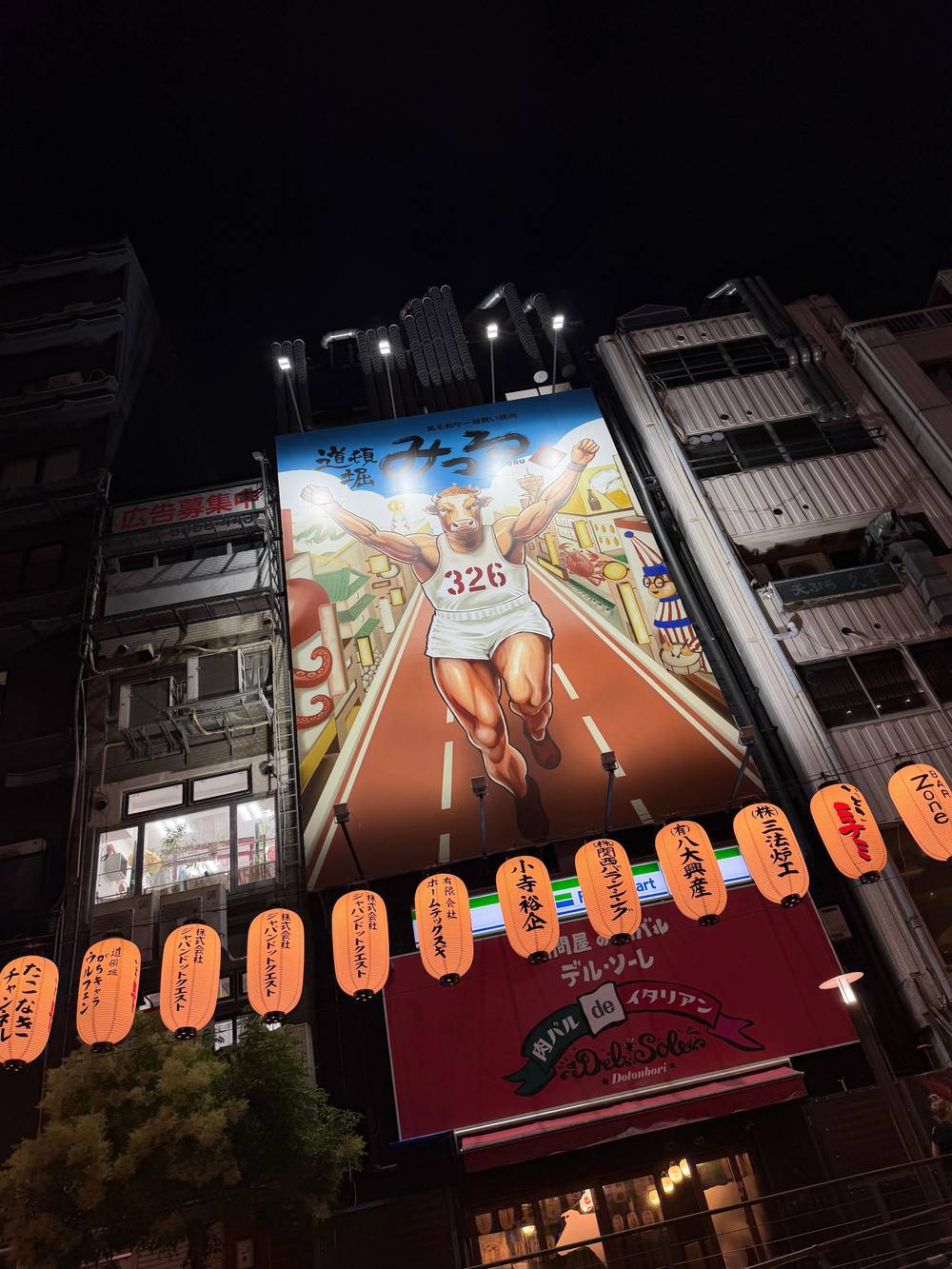
The Glico runner is not alone. The Osaka tourism bureau notes that some of the district's signs have gained fame across Japan and even overseas, like Glico's Running Man beside Ebisu-bashi Bridge, the enormous pincer-snapping crab on the Kani Doraku facade and the scowling chef of Kushikatsu Daruma.34
The same bureau lists the huge signs of Glico, Kani Doraku, Osaka Ohsho, Kinryu Ramen and Meiji's Karl.35 Kuidaore Taro, the drum-playing clown near the bridge, was made by a Bunraku puppeteer, and the bureau calls him Japan's first robot billboard.36 The bureau's own list gives you a ready checklist for a slow walk along the canal.
Newer attractions keep joining the old ones. The tourism bureau mentions the Tombori Riverwalk, which has gained popularity in recent years, and the Daruma Minister landmark on the Kushikatsu Daruma rooftop, which draws attention for its rotating gimmick.37 Give the Glico sign its pause and then follow the neon along the water.
FAQ
Fast, clear answers, short.
When was the first Glico sign built in Dotonbori?
Chuo Ward Office dates the first Glico neon tower beside Ebisubashi to 1935.1
How many versions of the Glico sign have there been?
Chuo Ward Office says the present sign is the sixth.2
What time does the Glico sign light up?
The sixth sign is lit from 18:00 and switched off at 24:00.4
How tall is the Glico sign?
The present sign measures 20.00 meters by 10.38 meters.3
Is the Glico sign neon or LED now?
The sixth sign carries 143,976 LED chips.24
Where is the Glico sign?
Chuo Ward gives its address as 1-10-1 Dotonbori.5
When is the best time to photograph the Glico sign?
The tourism bureau puts the best time for photography after sunset, when the neon lights shine.6
Can I see the Glico sign from a boat?
The river cruise on this site runs 20 minutes and names the sign in its listing title.
Sources
- Chuo Ward Office, Osaka City · Dotonbori Glico Sign ↩
- Chuo Ward Office, Osaka City · Dotonbori Glico Sign ↩
- Chuo Ward Office, Osaka City · Dotonbori Glico Sign ↩
- Chuo Ward Office, Osaka City · Dotonbori Glico Sign ↩
- Chuo Ward Office, Osaka City · Dotonbori Glico Sign ↩
- Osaka Convention & Tourism Bureau · Ebisubashi/Ebisu Bridge (OSAKA-INFO EXPERIENCE) ↩
- Japan National Tourism Organization · Dotonbori ↩
- Ezaki Glico · Company history ↩
- Osaka Convention & Tourism Bureau · A model itinerary for Osaka Minami ↩
- Chuo Ward Office, Osaka City · Dotonbori Glico Sign ↩
- Chuo Ward Office, Osaka City · Dotonbori Glico Sign ↩
- Chuo Ward Office, Osaka City · Dotonbori Glico Sign ↩
- Chuo Ward Office, Osaka City · Dotonbori Glico Sign ↩
- Chuo Ward Office, Osaka City · Dotonbori Glico Sign ↩
- Chuo Ward Office, Osaka City · Dotonbori Glico Sign ↩
- Chuo Ward Office, Osaka City · Dotonbori Glico Sign ↩
- Chuo Ward Office, Osaka City · Dotonbori Glico Sign ↩
- Chuo Ward Office, Osaka City · Dotonbori Glico Sign ↩
- Chuo Ward Office, Osaka City · Dotonbori Glico Sign ↩
- Chuo Ward Office, Osaka City · Dotonbori Glico Sign ↩
- Chuo Ward Office, Osaka City · Dotonbori Glico Sign ↩
- Chuo Ward Office, Osaka City · Dotonbori Glico Sign ↩
- Chuo Ward Office, Osaka City · Dotonbori Glico Sign ↩
- Chuo Ward Office, Osaka City · Dotonbori Glico Sign ↩
- Osaka Convention & Tourism Bureau · Tombori River Walk (OSAKA-INFO EXPERIENCE) ↩
- Osaka Convention & Tourism Bureau · Photo spots for Osaka’s nightscape (Discover Osaka) ↩
- Osaka Convention & Tourism Bureau · Namba and Shinsekai itinerary ↩
- Chuo Ward Office, Osaka City · Dotonbori Glico Sign ↩
- Chuo Ward Office, Osaka City · Dotonbori Glico Sign ↩
- Osaka Convention & Tourism Bureau · Namba and Shinsekai itinerary ↩
- Osaka Convention & Tourism Bureau · Photo spots for Osaka’s nightscape (Discover Osaka) ↩
- NOAA · Global Summary of the Month, Station Osaka (rainfall) and Kobe (temperatures) (NOAA GHCN JAM00047772 and JA000047770), 1971 to 2020 ↩
- Japan Tourism Agency · Cruising the Dotonbori Canal ↩
- Osaka Convention & Tourism Bureau · Kita and Minami itinerary (Dotonbori) ↩
- Osaka Convention & Tourism Bureau · Dotonbori (OSAKA-INFO EXPERIENCE) ↩
- Osaka Convention & Tourism Bureau · Dotonbori Tourist Guide (gourmet) ↩
- Osaka Convention & Tourism Bureau · Dotonbori Tourist Guide ↩
Also worth reading