Your stop on the map
The Dotonbori River, a canal that became a stage
See all 21 stops
The bridge corner, the canal and Minami, pin by pin
First pick a route, then tap any pin or stop for details and Google Maps.
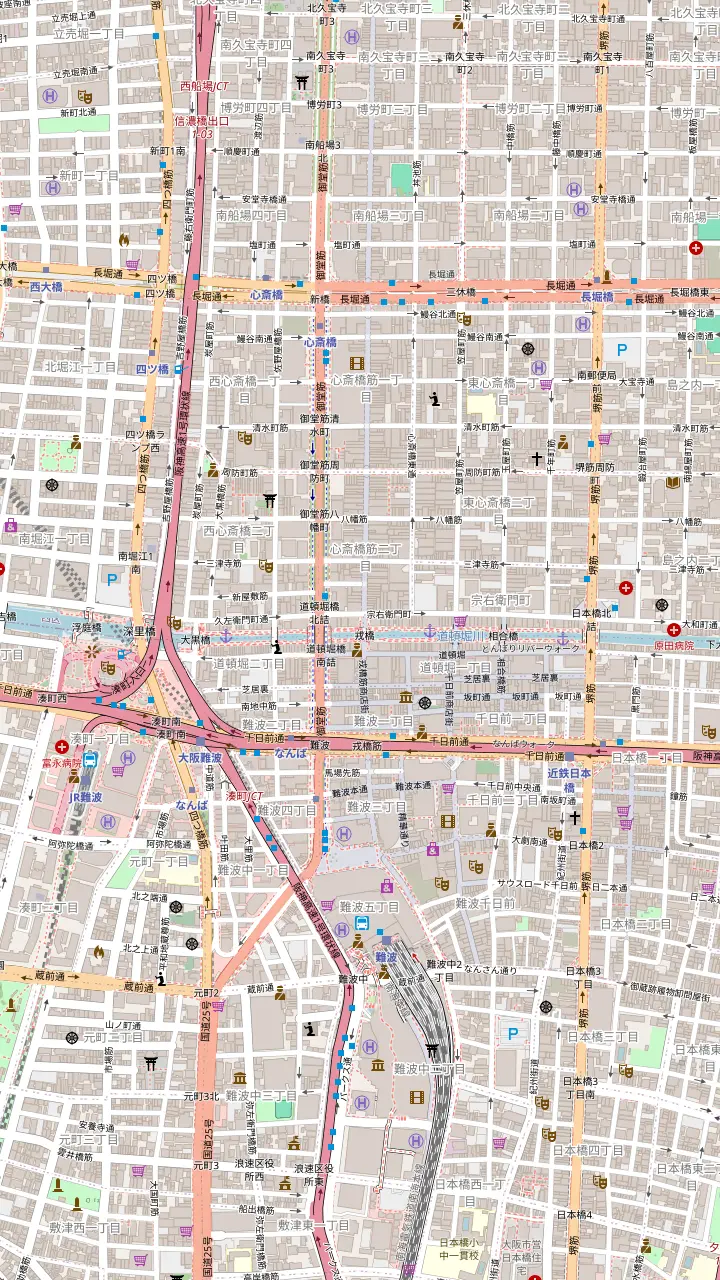
A 26-meter bridge joining Shinsaibashi-suji and Ebisubashi-suji.
Google MapsThe sixth sign, completed on 23 October 2014, stands at 1-10-1 Dotonbori.
Google MapsThe giant crab sign is on the Kani Doraku facade.
Google MapsThe Nakaza Kuidaore Building is marked by Kuidaore Taro, made by a Bunraku puppeteer.
Google MapsThe wheel is 77.4 meters tall and stands at the Don Quijote Dotonbori store.
Google MapsKabuki is performed at the Shochikuza Theater today.
Google MapsTwo alleyways 80 meters long and 3 meters wide, a 5-minute walk from Namba Station.
Google MapsWalk the length of the arcade and you emerge at Ebisubashi bridge.
Google MapsDotonbori is right outside the station.
Google Maps
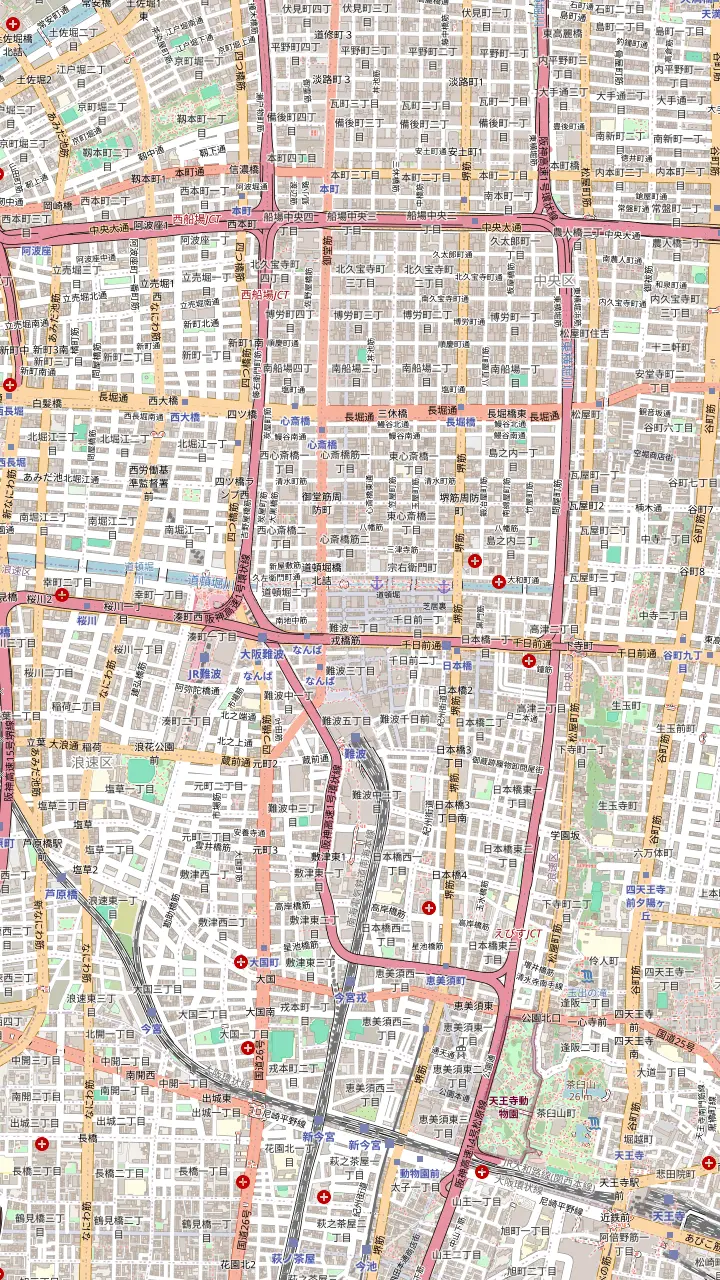
A pedestrian span built in 2008 to connect the Horie district to the canal's southern shore.
Google MapsThe river is about 50 m wide in the west and about 30 m in the east, with the change around this bridge.
Google MapsApart from Nippon-bashi, every bridge across the canal was first built by a private citizen.
Google MapsOne of over 10 small bridges across the river, each with a story of its own.
Google MapsPuppet theater is performed here today.
Google MapsComedy is performed here today.
Google Maps
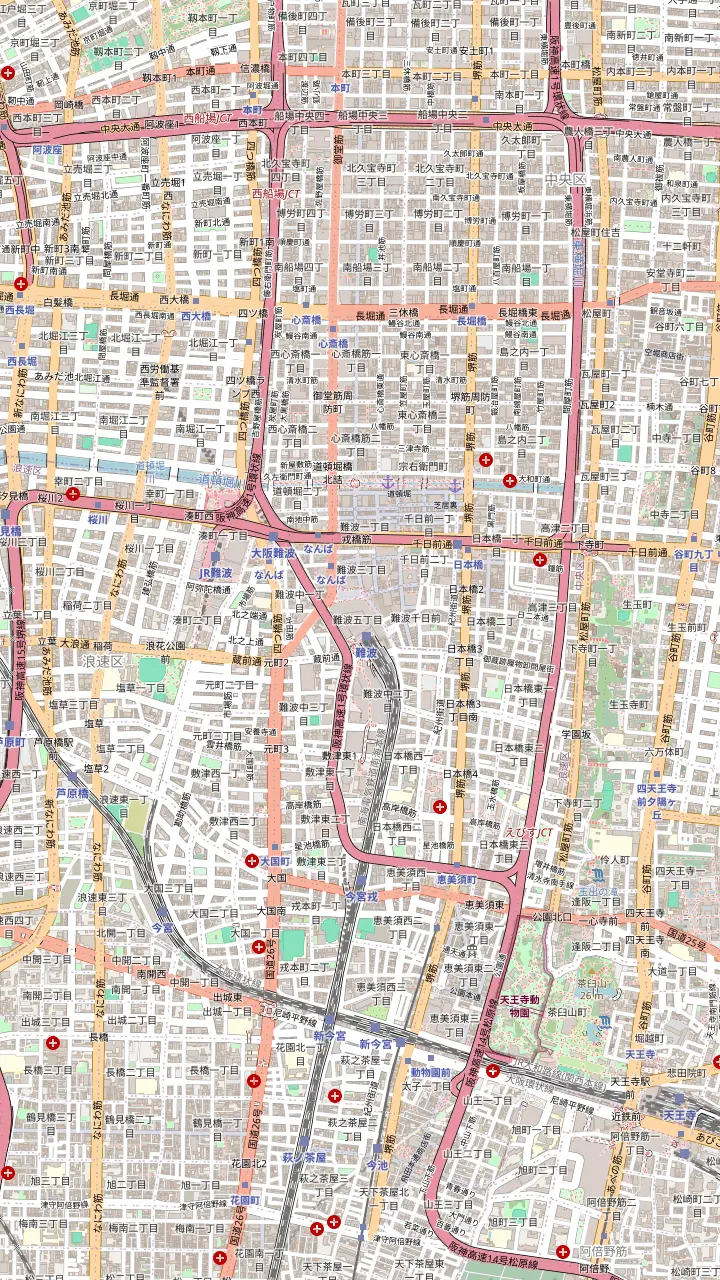
The most widely accepted theory is that Ebisu Bridge was part of the approach to this shrine.
Google MapsShinsekai is famous for Tsutenkaku Tower, Janjan Yokocho Street and a giant pufferfish lantern sign.
Google MapsIts lion-head votive plaque measures 12 meters high, 11 meters wide and 10 meters deep.
Google MapsNamba Parks opened in October 2003, and its rooftop garden holds about 70,000 plants.
Google MapsThe Midosuji Line runs to this station, with an exit to the Shinsaibashi-suji arcade.
Google MapsThe tourism bureau calls it an area for Osaka's younger crowd.
Google Maps
© OpenStreetMap contributors · map data
A merchant's canal project turned a muddy bank into Osaka's theater district, and the theaters are mostly gone while the lights and the food stayed. This page tells the story and pins the places you can still find.
Editorial team, dotonboririvercruise.click · Updated November 6, 2026 · 7 min of reading
Quick look
- DugTourism guides date the digging to 1612 and credit Doton Yasui, who gave his wealth for it.1
- CompletedThe canal was completed in 1615.2
- LengthThe river is about 2.7 km long.3
- TheatersWithin 50 years the area boasted six kabuki and five bunraku theaters.4
- RiverwalkThe Tombori Riverwalk promenade was built in December 2004.5
What the river is, and where it runs
People who ask what is Dotonbori usually mean the neon street, but the name belongs first to a waterway. The Osaka tourism bureau describes the Dotonbori River as a Class A river that connects the Higashiyokobori River and the Kizu River,6 about 2.7 km long, with a drainage area of about 4 km².3 The Japan National Tourism Organization adds that the district sits beside a 400-year-old canal.7
The river is not the same width along its length. The bureau gives about 50 m in the western Dotonbori section and about 30 m in the eastern section, with the change around Daikoku Bridge near the center.8 The narrow eastern stretch is the one with the signs and the crowds. The wider western stretch is quieter and runs toward the Ukiniwa-bashi footbridge.
The district took its name from the water. The tourism bureau calls Dotonbori the part of Osaka commonly referred to as Minami, which means south in Japanese, and a hub for youth culture and new trends.9 That explains why the canal is the starting point for so many Osaka itineraries: its story is the story of how the district began.
Then and now
What the canal had and what it has now
| Subject | In the past | Today |
|---|---|---|
| Theaters | Five Playhouses on the south bank19 | Kabuki at the Shochikuza20 |
| Puppet theater | Takemoto-za and Toyotake-za12 | National Bunraku Theater20 |
| Comedy | Part of the district's live scene21 | Namba Grand Kagetsu and Kadoza20 |
| Food | Restaurants fed theatergoers22 | Kuidaore culture23 |
| Signs | Billboards vied for notice24 | Glico, the crab and the chef24 |
| Waterfront | A city of 808 bridges25 | A promenade built in 20045 |
Descriptions come from the Osaka tourism bureau and the Japan Tourism Agency; cells that do not name a venue describe the district in general.21
Who dug it, and when
The name has a founder. Osaka's tourism guide says Dotonbori comes from Doton Yasui, the name of a man who devoted his wealth to having this river excavated in 1612.1 Another page from the bureau says Yasui Doton put up his own fortune for the digging roughly 12 years after the Battle of Sekigahara.14 Another bureau page writes the year the canal was completed as 1615.2 Read together, the dates describe a project that took a few years.
The details of the founder are thin. The bureau notes that records are sparse, but it seems the development was named in tribute to Doton after he died in the 1615 Siege of Osaka.10 That means the man who gave the canal its name may not have lived to see it finished, a fact that adds a note of melancholy to the busiest street in the city.
You can still find a trace of him. The tourism bureau says Shorin-an, the cemetery management building of Mitsudera in Sennichimae, is home to the grave of Yasui Doton, who is said to have excavated the canal.15 It is a quiet corner a short walk from the neon, and it makes a good first stop if you like to see where a name comes from.
A kabuki quarter on the south bank
Once the water was there, the entertainers followed. The tourism bureau's Dotonbori essay says that in 1626 Yasui Kyubei, one of Doton's collaborators, was granted permission to transfer a nearby theater district to the banks of the new canal.11 Theaters, teahouses and restaurants soon lined the water, and wealthy merchants glided up the canal in their boats and docked outside the place of their choice.28
The largest theaters lined the canal's southern bank and were known as the Five Playhouses, or Goza.19 The tourism organization says that within 50 years the area boasted six kabuki and five bunraku theaters.4 The bureau adds that the district became a mecca for performing arts, a stage as coveted as Broadway.29
Two of the playhouses are remembered for particular plays. The bureau says Takemoto-za and Toyotake-za were bunraku puppet theaters whose fierce rivalry produced masterpieces, including Chikamatsu Monzaemon's Love Suicides at Sonezaki, which debuted at Takemoto-za in 1703.12 The canal was a creative workshop as well as an entertainment strip, and that is part of why its signs have always had a theatrical streak.
Choose your angle
Which part of the story do you want?
Match your interest to a place on the map and a way to see it.
If I want the canal itself
Walk the Tombori Riverwalk
About 600 m has been improved for strolling.18
If I want the theaters
Shochikuza, Bunraku and Kagetsu
Each of them still hosts performances today.20
If I want the bridges
Cruise under them
The cruise runs under Ebisu-bashi Bridge.26
If I want street art
Look for Dotonbori Art
Wall art has appeared on the Riverwalk since 2019.27
If I want the founder
Find Shorin-an in Sennichimae
It holds the grave of Yasui Doton.15
How the theaters faded and the food stayed
In the twentieth century the playhouses lost their audience to the cinema. The bureau says that the last of the Five Playhouses, Naka-za, staged its final performance in 1999.13 The Shochiku-za is a newer theater: it opened in 1923 as a movie and revue theater in the Art Deco style and pivoted to kabuki and traditional performing arts in 1999.50
According to the tourism bureau, restaurants appeared of their own accord to feed theatergoers, and their numbers kept growing.22 It adds that the restaurants of Dotonbori continued to thrive throughout the upheaval, and that in the 1920s and 1930s a wave of cafes brought European sensibilities and American jazz to the neighborhood.23 The food outlasted the stage.
Some live entertainment remains. The bureau lists kabuki at the Shochikuza Theater, puppet theater at the National Bunraku Theater, and comedy at the Namba Grand Kagetsu Theater and Kadoza Theater.20 The tourism bureau sums up how the district got here: the prosperity of the town as an entertainment district of theater and kabuki, and an increase of teahouses, became the basis for its status as a place for food and live entertainment.21
Price a canal cruise
What a cruise on the canal costs for your group
Add your party and compare three ways to float along the Dotonbori River.
3 options compared
What a cruise on the canal costs for your group
Add your party and compare three ways to float along the Dotonbori River.
- Dotonbori river cruise20 minutes · starting at, per person $13
≈
View - River cruise with drinkDrink discount · starting at, per person $13
≈
View - Pirates cruise25 minutes · starting at, per person $11
≈
View
From-prices on GetYourGuide, shown at the ECB reference rate. Your exact price is confirmed during booking.
Four centuries on one canal
From the digging to the riverwalk
1612
Digging begins
Tourism guides date the excavation to 1612.1
1615
Canal completed
The canal was completed, and Doton died in the Siege of Osaka.2,10
1626
Theaters move in
A nearby theater district was transferred to the canal banks.11
1703
A hit at Takemoto-za
Love Suicides at Sonezaki debuted at the bunraku theater.12
1999
Last playhouse closes
Naka-za staged its final performance.13
2004
Riverwalk opens
The Tombori Riverwalk promenade was built in December.5
Signs and the fight for attention
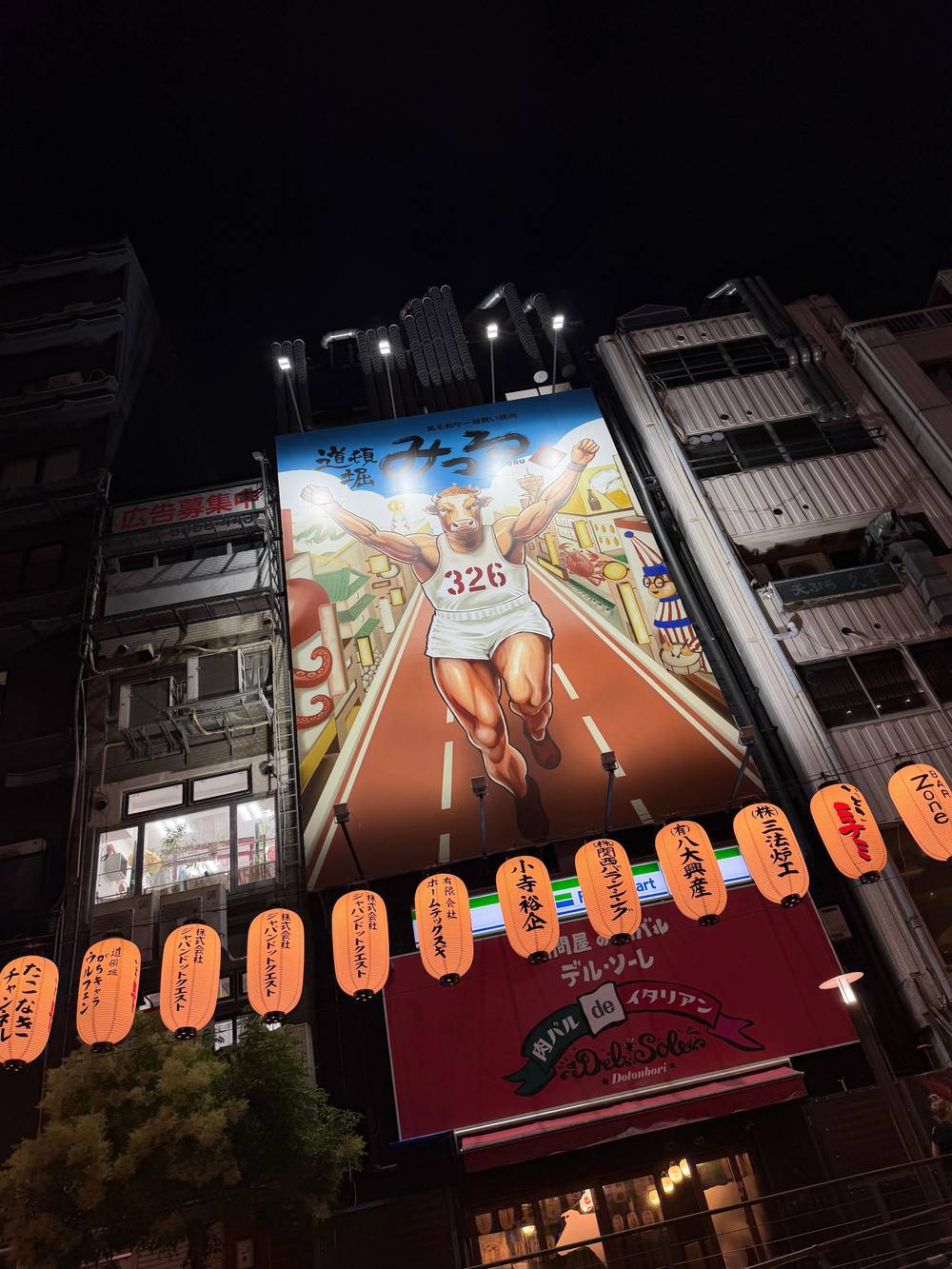
As the stages gave way to restaurants, the buildings turned into billboards. The tourism bureau describes the Dotonbori restaurants competing for attention with a riot of neon signage and giant signs, and names Glico's Running Man beside Ebisu-bashi Bridge, the pincer-snapping crab of Kani Doraku and the scowling chef of Kushikatsu Daruma.24
The bureau's list of huge signs also includes Osaka Ohsho, Kinryu Ramen and Meiji's Karl.51 The figure of Kuidaore Taro at the Nakaza Kuidaore Building was made by a Bunraku puppeteer, and the bureau calls it Japan's first robot billboard.33 The puppet link ties the modern sign back to the old playhouses.
The signs are best read as the stage lights of a theater that never closed. If you want the full story of the best-known one, our page on the Glico sign follows its editions from the first neon tower to the LED screen of today. The page on Ebisu Bridge tells the story of the crossing that the sign overlooks, and both pair well with a slow walk along the water.
Video
Dotonbori: a brief history of Osaka's most famous district
Japan Experiences on YouTube · Until you tap play, no video is loaded.
Records are sparse, but it seems that the development was named in tribute to Doton after he died in the 1615 Siege of Osaka.
Walking the canal
A short checklist for the water's edge
Getting started3
Along the way3
On the boat3
- Cancel up to 24 hours before for a full refund
- The cruise starts from $13
- The cruise runs 20 minutes
The riverwalk and the bridges today
The canal's banks were opened to walkers in recent decades. The tourism bureau's convention pages say the Tombori Riverwalk promenade was built in December 2004.5 About 600 m between Ebisu Bridge and the Nipponbashi and Minatomachi area has been improved,18 and the Riverwalk is about a 10-minute walk from Osaka Metro Namba Station.48 Dotonbori Art wall art has also appeared along it since 2019.27
The bridges are part of the walk. The Japan Tourism Agency says that apart from Nippon-bashi, which the Tokugawa shogunate built as a public works project, every bridge across the canal was first built by a private citizen.39 The bureau counts over 10 small bridges, such as Aiai Bridge and Ebisu Bridge, each with a story of its own.40
The newest span is a footbridge. The agency says Ukiniwa-bashi was built in 2008 to connect the Horie district to the canal's southern shore.38 A word of realism about the water: the tourism bureau says it is not particularly clean,49 so enjoy the canal from the banks and the boats rather than in it.
Seeing the canal from the water
Osaka was once a city that lived on its waterways. The Japan Tourism Agency says that by early modern times it was known as the city of 808 bridges,25 and that the city launched a campaign in 2001 to revive waterfront life for visitors and residents.52 A cruise on the Dotonbori canal is part of that revival.
The agency describes a popular cruise that runs along the canal, under Ebisu-bashi Bridge and past Glico's Running Man sign, led by a guide who keeps up a steady commentary in the Osaka dialect.26 The cruise offered on this site is a 20-minute trip on the Dotonbori River that starts from $13 and is rated 4.5 from 1,751 reviews.
Whether you go by boat or on foot, the map at the top of this page gives you the bridges, theaters and shrines in order from west to east. Start on the western side at the Ukiniwa footbridge, follow the river toward the signs and finish at the old theater street. If you only have an evening, join the canal at Ebisu Bridge and let the neon decide the rest.
FAQ
Fast, clear answers, short.
Who dug the canal?
The tourism guide says he devoted his wealth to having the river excavated in 1612.1
When was the canal completed?
The Japan Tourism Agency says the canal was completed in 1615.2
How long is the Dotonbori River?
The river is about 2.7 km long, with a drainage area of about 4 km².3
What was Dotonbori famous for in the past?
The area boasted six kabuki and five bunraku theaters within 50 years.4
When did the last of the old playhouses close?
Naka-za staged its final performance in 1999.13
When was the Tombori Riverwalk built?
The promenade was built in December 2004.5
Is the Dotonbori River clean enough to swim in?
The tourism bureau says the water is not particularly clean.49
Sources
- Osaka Convention & Tourism Bureau · Dotonbori Tourist Guide ↩
- Japan Tourism Agency · Cruising the Dotonbori Canal ↩
- Osaka Convention & Tourism Bureau · Dotonbori River (OSAKA-INFO EXPERIENCE) ↩
- Japan National Tourism Organization · Dotonbori ↩
- Osaka Convention & Tourism Bureau (MICE) · Tombori Riverwalk ↩
- Osaka Convention & Tourism Bureau · Dotonbori River (OSAKA-INFO EXPERIENCE) ↩
- Japan National Tourism Organization · Dotonbori & Shinsaibashi ↩
- Osaka Convention & Tourism Bureau · Dotonbori River (OSAKA-INFO EXPERIENCE) ↩
- Osaka Convention & Tourism Bureau · Dotonbori (OSAKA-INFO EXPERIENCE) ↩
- Osaka Convention & Tourism Bureau · Kita and Minami itinerary (Dotonbori) ↩
- Osaka Convention & Tourism Bureau · Kita and Minami itinerary (Dotonbori) ↩
- Osaka Convention & Tourism Bureau · Kita and Minami itinerary (Dotonbori) ↩
- Osaka Convention & Tourism Bureau · Kita and Minami itinerary (Dotonbori) ↩
- Osaka Convention & Tourism Bureau · Dotonbori Tourist Guide (gourmet) ↩
- Osaka Convention & Tourism Bureau · Mittera temple (OSAKA-INFO EXPERIENCE) ↩
- Osaka Convention & Tourism Bureau · Ebisubashi/Ebisu Bridge (OSAKA-INFO EXPERIENCE) ↩
- Osaka Convention & Tourism Bureau · Hozenji Yokocho Alley ↩
- Osaka Convention & Tourism Bureau · Tombori River Walk (OSAKA-INFO EXPERIENCE) ↩
- Osaka Convention & Tourism Bureau · Kita and Minami itinerary (Dotonbori) ↩
- Osaka Convention & Tourism Bureau · Dotonbori Tourist Guide (gourmet) ↩
- Osaka Convention & Tourism Bureau · Dotonbori Tourist Guide ↩
- Osaka Convention & Tourism Bureau · Dotonbori Tourist Guide (gourmet) ↩
- Osaka Convention & Tourism Bureau · Kita and Minami itinerary (Dotonbori) ↩
- Osaka Convention & Tourism Bureau · Kita and Minami itinerary (Dotonbori) ↩
- Japan Tourism Agency · Cruising the Dotonbori Canal ↩
- Japan Tourism Agency · Cruising the Dotonbori Canal ↩
- Osaka Convention & Tourism Bureau · Tombori River Walk (OSAKA-INFO EXPERIENCE) ↩
- Osaka Convention & Tourism Bureau · Kita and Minami itinerary (Dotonbori) ↩
- Osaka Convention & Tourism Bureau · Dotonbori Tourist Guide (gourmet) ↩
- Chuo Ward Office, Osaka City · Dotonbori Glico Sign
- Chuo Ward Office, Osaka City · Dotonbori Glico Sign
- Osaka Convention & Tourism Bureau · Ebisubashi/Ebisu Bridge (OSAKA-INFO EXPERIENCE)
- Osaka Convention & Tourism Bureau · Dotonbori Tourist Guide (gourmet) ↩
- Osaka Convention & Tourism Bureau · Don Quijote Dotonbori Ferris Wheel (OSAKA-INFO EXPERIENCE)
- Osaka Convention & Tourism Bureau · Hozenji Yokocho Alley
- Japan National Tourism Organization · Dotonbori & Shinsaibashi
- Osaka Convention & Tourism Bureau · Dotonbori Tourist Guide
- Japan Tourism Agency · Cruising the Dotonbori Canal ↩
- Japan Tourism Agency · Cruising the Dotonbori Canal ↩
- Osaka Convention & Tourism Bureau · Dotonbori (OSAKA-INFO EXPERIENCE) ↩
- Osaka Convention & Tourism Bureau · Ebisubashi/Ebisu Bridge (OSAKA-INFO EXPERIENCE)
- Osaka Convention & Tourism Bureau · Shinsekai
- Osaka Convention & Tourism Bureau · Namba Yasaka Shrine
- Osaka Convention & Tourism Bureau · Namba Parks (OSAKA-INFO EXPERIENCE)
- Osaka Convention & Tourism Bureau · Namba Parks (OSAKA-INFO EXPERIENCE)
- Japan National Tourism Organization · Dotonbori & Shinsaibashi
- Osaka Convention & Tourism Bureau · Shinsaibashi (OSAKA-INFO EXPERIENCE)
- Osaka Convention & Tourism Bureau · Tombori River Walk (OSAKA-INFO EXPERIENCE) ↩
- Osaka Convention & Tourism Bureau · Dotonbori River (OSAKA-INFO EXPERIENCE) ↩
- Osaka Convention & Tourism Bureau · Kita and Minami itinerary (Dotonbori) ↩
- Osaka Convention & Tourism Bureau · Dotonbori (OSAKA-INFO EXPERIENCE) ↩
- Japan Tourism Agency · Cruising the Dotonbori Canal ↩
Also worth reading